

Extra and far more goods and solutions are getting gain of the modeling and prediction capabilities of AI. This posting offers the nvidia-docker tool for integrating AI (Artificial Intelligence) computer software bricks into a microservice architecture. The most important advantage explored right here is the use of the host system’s GPU (Graphical Processing Device) resources to accelerate multiple containerized AI purposes.
To realize the usefulness of nvidia-docker, we will start by describing what kind of AI can gain from GPU acceleration. Secondly we will existing how to carry out the nvidia-docker resource. Ultimately, we will explain what equipment are accessible to use GPU acceleration in your programs and how to use them.
Why working with GPUs in AI applications?
In the discipline of artificial intelligence, we have two major subfields that are made use of: device studying and deep discovering. The latter is aspect of a greater household of equipment discovering approaches based on artificial neural networks.
In the context of deep finding out, where operations are essentially matrix multiplications, GPUs are far more successful than CPUs (Central Processing Models). This is why the use of GPUs has grown in the latest several years. Without a doubt, GPUs are considered as the heart of deep studying due to the fact of their massively parallel architecture.
Nonetheless, GPUs can’t execute just any program. In fact, they use a certain language (CUDA for NVIDIA) to get edge of their architecture. So, how to use and talk with GPUs from your programs?
The NVIDIA CUDA technological know-how
NVIDIA CUDA (Compute Unified Product Architecture) is a parallel computing architecture combined with an API for programming GPUs. CUDA interprets application code into an instruction established that GPUs can execute.
A CUDA SDK and libraries such as cuBLAS (Simple Linear Algebra Subroutines) and cuDNN (Deep Neural Community) have been made to communicate quickly and competently with a GPU. CUDA is obtainable in C, C++ and Fortran. There are wrappers for other languages together with Java, Python and R. For illustration, deep finding out libraries like TensorFlow and Keras are based mostly on these technologies.
Why working with nvidia-docker?
Nvidia-docker addresses the needs of developers who want to include AI operation to their programs, containerize them and deploy them on servers run by NVIDIA GPUs.
The goal is to set up an architecture that will allow the improvement and deployment of deep discovering styles in products and services readily available by means of an API. Hence, the utilization amount of GPU means is optimized by making them accessible to multiple application scenarios.
In addition, we benefit from the rewards of containerized environments:
- Isolation of cases of each and every AI product.
- Colocation of a number of products with their certain dependencies.
- Colocation of the very same product less than many variations.
- Steady deployment of models.
- Product performance monitoring.
Natively, making use of a GPU in a container requires setting up CUDA in the container and offering privileges to obtain the device. With this in head, the nvidia-docker software has been created, allowing for NVIDIA GPU units to be uncovered in containers in an isolated and protected method.
At the time of composing this article, the hottest version of nvidia-docker is v2. This variation differs considerably from v1 in the following approaches:
- Model 1: Nvidia-docker is executed as an overlay to Docker. That is, to produce the container you had to use nvidia-docker (Ex:
nvidia-docker run ...) which performs the steps (amongst some others the creation of volumes) allowing for to see the GPU products in the container. - Version 2: The deployment is simplified with the substitution of Docker volumes by the use of Docker runtimes. Indeed, to start a container, it is now required to use the NVIDIA runtime by means of Docker (Ex:
docker operate --runtime nvidia ...)
Observe that because of to their unique architecture, the two versions are not suitable. An application published in v1 will have to be rewritten for v2.
Placing up nvidia-docker
The expected aspects to use nvidia-docker are:
- A container runtime.
- An accessible GPU.
- The NVIDIA Container Toolkit (most important section of nvidia-docker).
Prerequisites
Docker
A container runtime is required to operate the NVIDIA Container Toolkit. Docker is the suggested runtime, but Podman and containerd are also supported.
The official documentation offers the set up process of Docker.
Driver NVIDIA
Drivers are demanded to use a GPU product. In the scenario of NVIDIA GPUs, the motorists corresponding to a offered OS can be attained from the NVIDIA driver down load web site, by filling in the info on the GPU design.
The set up of the drivers is performed by using the executable. For Linux, use the pursuing commands by changing the identify of the downloaded file:
chmod +x NVIDIA-Linux-x86_64-470.94.operate
./NVIDIA-Linux-x86_64-470.94.run
Reboot the host machine at the conclusion of the set up to choose into account the set up drivers.
Putting in nvidia-docker
Nvidia-docker is obtainable on the GitHub task site. To install it, adhere to the set up guide dependent on your server and architecture particulars.
We now have an infrastructure that lets us to have isolated environments providing access to GPU assets. To use GPU acceleration in programs, a number of tools have been made by NVIDIA (non-exhaustive listing):
- CUDA Toolkit: a set of resources for establishing computer software/applications that can carry out computations applying both equally CPU, RAM, and GPU. It can be utilised on x86, Arm and Energy platforms.
- NVIDIA cuDNN: a library of primitives to accelerate deep understanding networks and optimize GPU overall performance for big frameworks these as Tensorflow and Keras.
- NVIDIA cuBLAS: a library of GPU accelerated linear algebra subroutines.
By applying these instruments in application code, AI and linear algebra duties are accelerated. With the GPUs now seen, the software is able to deliver the facts and operations to be processed on the GPU.
The CUDA Toolkit is the cheapest degree possibility. It offers the most control (memory and directions) to make customized purposes. Libraries give an abstraction of CUDA features. They allow you to focus on the application enhancement somewhat than the CUDA implementation.
At the time all these components are executed, the architecture working with the nvidia-docker assistance is completely ready to use.
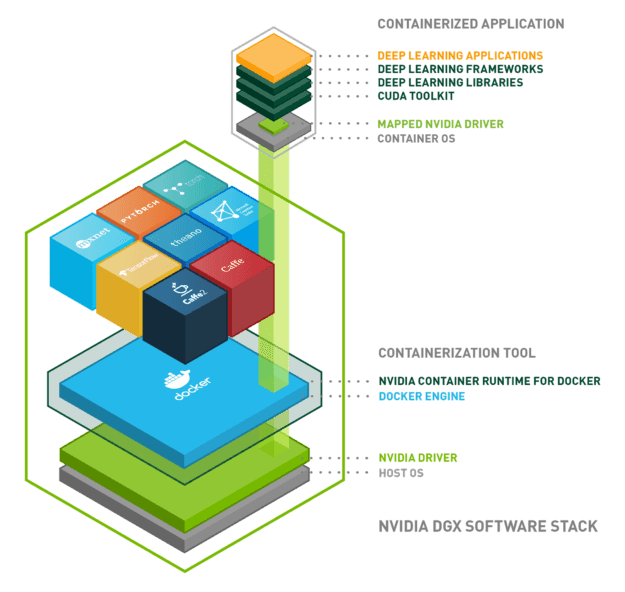
Listed here is a diagram to summarize all the things we have viewed:
Conclusion
We have established up an architecture letting the use of GPU resources from our purposes in isolated environments. To summarize, the architecture is composed of the pursuing bricks:
- Operating technique: Linux, Windows …
- Docker: isolation of the natural environment using Linux containers
- NVIDIA driver: installation of the driver for the hardware in question
- NVIDIA container runtime: orchestration of the former 3
- Programs on Docker container:
- CUDA
- cuDNN
- cuBLAS
- Tensorflow/Keras
NVIDIA carries on to establish equipment and libraries all-around AI technologies, with the target of setting up by itself as a chief. Other systems might complement nvidia-docker or may perhaps be extra suited than nvidia-docker based on the use case.
About the Author
